
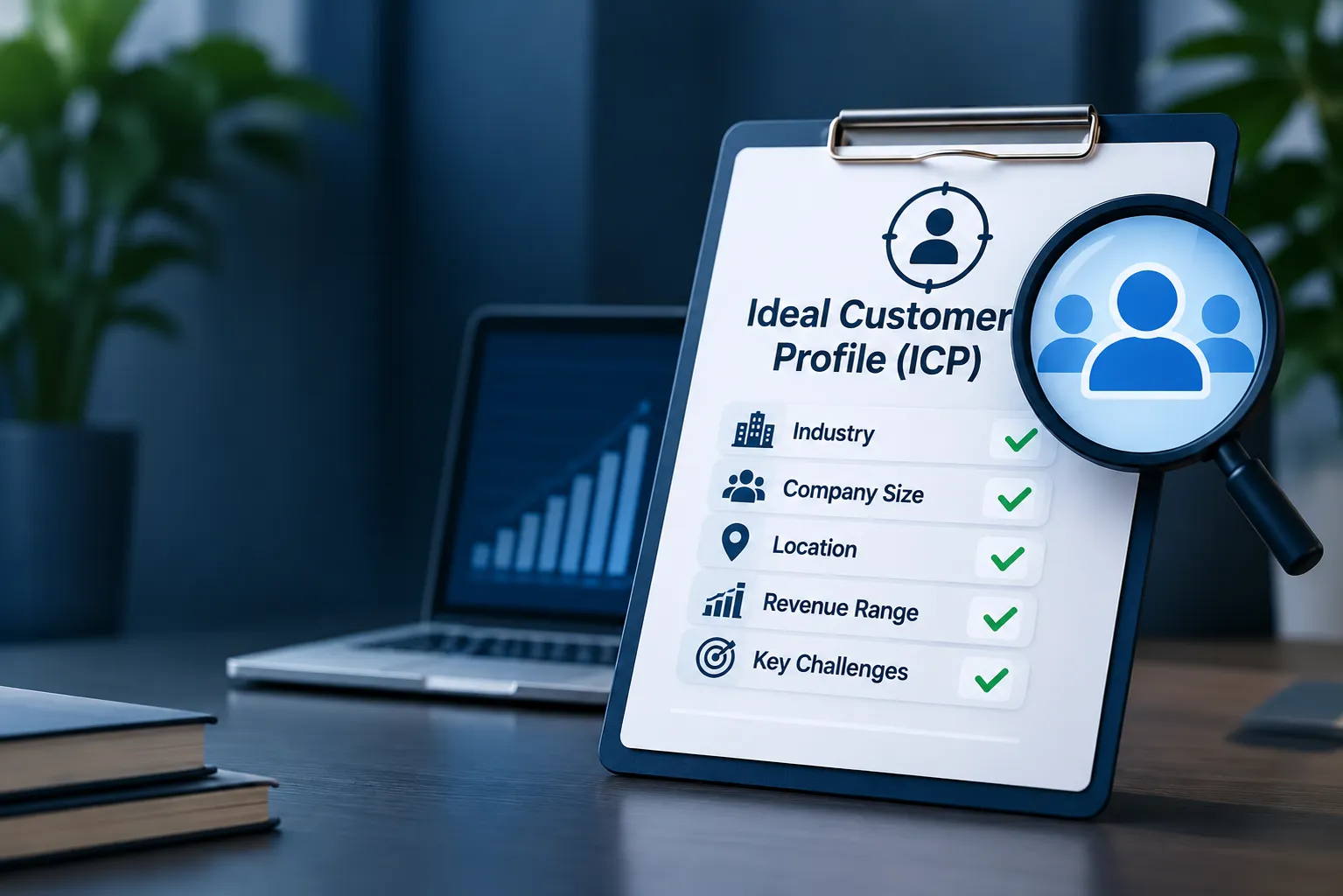
Your B2B Ideal Customer Profile (ICP) defines the companies most likely to buy your solution, benefit from it, and become profitable long-term customers.
Without a clear ICP, your sales team chases poor-fit opportunities, marketing attracts the wrong prospects, and your budget gets spread across businesses that were never a good match.
The goal isn’t to find more companies to sell to. It’s to identify the ones worth pursuing.
What Is an Ideal Customer Profile in B2B?
A B2B Ideal Customer Profile (ICP) is a research-backed description of the type of company that represents the strongest commercial fit for your product or service.
It combines company characteristics, business challenges, buying requirements, and historical customer performance to identify your highest-value prospects.
For example, “B2B companies in the United States” is a target market, not a useful ICP.
A more actionable profile would be:
“US-based B2B SaaS companies with 50–200 employees, an established sales team, and inconsistent inbound pipeline despite investing in marketing.”
This describes a recognizable group of businesses with a specific problem your offering can address.
Your Biggest Customer Isn’t Automatically Your Ideal Customer
A high-revenue account that requires excessive support, has poor margins, or regularly expands the scope of work can be less valuable than a smaller, profitable client who stays longer. Build your ICP around customer fit and lifetime economics, not deal size alone.
What Information Should Your B2B ICP Include?
A useful ICP includes characteristics you can actually verify and apply when evaluating prospective accounts.
| ICP Attribute | What to Define |
| Industry | The specific industries or market segments you serve |
| Company size | Employee count, annual revenue, or both |
| Geography | Countries or regions your business can support |
| Business maturity | Startup, growth-stage, established, or enterprise |
| Technology requirements | Systems or infrastructure needed for your solution |
| Business challenges | Problems your offering is built to solve |
| Buying triggers | Events that create urgency or demand |
| Commercial fit | Budget capacity, profitability, and retention potential |
| Disqualification criteria | Conditions that make an account unsuitable |
Not every attribute deserves equal weight.
For a technical integration service, existing infrastructure could be critical. For a strategic marketing consultancy, business maturity and internal team capabilities could matter more.
How to Build Your B2B Ideal Customer Profile in 6 Steps
1. Segment Your Market Before Analyzing Customers
Start by dividing your market into groups with genuinely different needs.
For example, a marketing consultancy serving software companies, manufacturers, and professional service firms should not automatically combine them into one ICP.
Their sales processes, buying priorities, and growth challenges differ.
Choose a segment based on three considerations:
- The problem your business solves particularly well.
- The segment’s ability and willingness to pay.
- Your evidence of successful customer outcomes.
A Helpful Exercise For You
Complete this sentence:
“We help [specific type of company] solve [specific business problem] when [business situation].”
This establishes an initial segment to investigate, not a final ICP.
Solution: B2B Positioning & Messaging Services
2. Find the Customers Who Deliver the Best Business Results
Review your customer base and identify the accounts that perform best commercially.
Examine:
- Revenue and profitability: Which customers generate strong margins?
- Retention: Which accounts maintain long-term relationships?
- Sales cycle: Which deals move from qualified opportunity to close efficiently?
- Customer success: Who achieves the outcomes your solution promises?
- Expansion: Which accounts purchase additional services or increase their investment?
The 80/20 principle provides a useful starting point, but don’t assume 20% of your customers generate exactly 80% of revenue.
Use your actual data.
Look for characteristics shared by your strongest customers. These patterns become the foundation of your ICP.
3. Interview Customers to Understand Why They Bought
Customer records explain who purchased. Interviews reveal why.
Speak with a small selection of successful customers and ask:
- What was happening in your business before you started looking for a solution?
- What finally made solving this problem a priority?
- What alternatives did you consider?
- What nearly prevented you from buying?
- How do you judge whether the investment was successful?
Keep the conversations focused on real experiences rather than hypothetical preferences. Pay special attention to the events that turned an existing problem into an immediate purchase decision. Those moments help distinguish a good-fit company from one actively ready to buy.
4. Analyze Won and Lost Deals to Establish Qualification Rules
Your best customers tell only half the story. Lost deals reveal where your targeting breaks down. Compare opportunities that closed successfully with those that stalled or failed.
Look for recurring disqualification signals, such as:
- No realistic budget for your solution.
- Missing technical or operational requirements.
- No internal resources to implement the service.
- A need your offering cannot adequately address.
- A purchasing process incompatible with your business model.
Separate poor fit from poor timing.
An otherwise suitable company without an approved budget this quarter is different from a business that cannot benefit from your offering.
Fit and Purchase Intent Are Different
An account can match every ICP criterion without being ready to buy. Company characteristics establish fit, while budget approval, upcoming deadlines, organizational changes, and active solution research indicate purchase readiness. Evaluate both before assigning sales priority.
5. Identify the Buying Committee and Purchase Process
The ICP defines the company. Your buyer personas describe the individuals who make or influence its purchasing decisions.
For a B2B software purchase, the buying committee could involve:
- Economic buyer: Approves the investment.
- Decision-maker: Leads the solution selection.
- Technical evaluator: Assesses compatibility, security, or implementation.
- End user: Evaluates how the solution works in daily operations.
Identify these roles using previous sales records and customer interviews.
Then document the approval process, expected purchasing timeline, and evaluation criteria.
This helps your team communicate with the right stakeholders without confusing company-level targeting with individual buyer characteristics.
6. Turn Your Findings Into an Actionable ICP
Now combine your research into a profile your sales and marketing teams can use.
Here’s a fictional example for a B2B growth consultancy.
| Example: Ideal Customer Profile | |
| Industry | B2B professional services |
| Company Size | 20–100 employees |
| Location | United States |
| Growth Stage | Established business preparing to scale |
| Primary Challenge | Heavy dependence on referrals for new business |
| Buying Trigger | New revenue targets requiring a more predictable acquisition process |
| Budget | Approved investment in external marketing strategy |
| Key Stakeholders | Founder, CEO, or Head of Marketing |
| Disqualification | No internal capacity to support execution or no commitment to developing a repeatable growth process |
Did you notice how specific the profile is?
A sales representative can use it to qualify opportunities. A marketer can use it to build relevant campaigns. Leadership can use it to decide which market segments deserve investment.
That’s what makes an ICP operational rather than decorative.
How to Use Your ICP Across Sales and Marketing
A completed ICP should directly influence which accounts enter your pipeline and how your business allocates acquisition resources.
For sales
Introduce account qualification rules and prioritize prospects by fit and buying readiness.
For marketing
Create campaigns around the problems, buying triggers, and search behavior of your highest-value customer segment.
For leadership
Compare acquisition cost, retention, profitability, and win rates across ICP-fit and non-ICP accounts.
Review the profile when customer performance changes, new segments emerge, or your offering evolves. If an important criterion consistently fails to predict good customers, update it.
Explore our Demand Generation service to connect your target accounts with a more focused acquisition strategy.
Frequently Asked Questions
1. What is the difference between an Ideal Customer Profile (ICP) and a buyer persona?
An Ideal Customer Profile (ICP) defines the ideal company, including its industry, size, requirements, and business challenges. A buyer persona describes a person involved in the purchase, including their responsibilities, motivations, and objections.
2. Can a B2B business have multiple ICPs?
Yes. Separate ICPs make sense when your business serves distinct customer segments with different needs, economics, or buying processes. Each profile should have a clear reason to exist and a defined commercial opportunity.
3. How can I create an ICP without existing customers?
Start with a hypothesis based on the problem your offering solves and the businesses experiencing it. Validate that hypothesis through market research, prospect interviews, and early sales conversations. Our Positioning & Messaging service helps establish a clearer target market and competitive direction.
4. How often should a B2B ICP be updated?
Review your ICP at least annually and after significant changes in customer performance, pricing, product capabilities, or market conditions. Update individual criteria when new evidence shows they no longer predict customer fit.
5. How does an ICP improve B2B lead generation?
An ICP helps focus acquisition efforts on companies with the strongest commercial fit. This gives marketing clearer targeting criteria and sales a more consistent way to prioritize leads. Explore our Demand Generation service to build an acquisition strategy around qualified opportunities.
6. How do I know if my ICP is too broad?
Your ICP is too broad when it includes businesses with substantially different problems, budgets, or purchase requirements that cannot be addressed with a coherent market position. Use our Brand Clarity Scorecard to start evaluating how clearly your business communicates whom it serves and why.
Turn Better Targeting Into Better Business
Stop investing in accounts that were never right for your business.
The B2B Digital helps B2B SaaS and service businesses identify their best-fit market, sharpen their messaging, and build strategies that attract qualified opportunities. Book a FREE Strategy Call and put your marketing investment behind the customers who matter most.
Book a FREE Strategy Call